
by Catarina Ferreira, AIA
What exactly does it mean for a building to be ‘contextual?’ In mainstream culture, particularly American culture, it’s often called ‘fitting in,’ or being ‘appropriate,’ replicating nearby architectural styles, regardless of era.
As a European-born and raised individual, even before attending architecture school, I already had an intuitive understanding of it which had nothing to do with style. While in architecture school at Syracuse University, that understanding was reinforced early on by the teachings of Werner Seligman, one of the legendary Texas Rangers, who revolutionized architectural education in the US, leaving their mark at universities like The University of Texas, Austin, Cornell University, Syracuse University, etc. Werner was a modernism to the core and his teachings resonated with me. I was fortunate to have been taken under Werner’s wing, a privilege not granted to many. He was as famous for making students cry as for his teachings.
Given my background and Werner’s modernist influence, ‘contextual’ to me has always meant, above all else, site-specific. It has never meant invisible, subservient to older buildings/styles, cowardly. After all, the present day is also part of history and history would be illegible if every building looked like a Roman temple, or, if we go back further, a cave. To me, it really is that simple.
On a recent residential project located in Washington DC’s Colonial Village, I had the opportunity to explore what it means to be contextual without creating a stylistic caricature of a neighborhood. Initially, the site conditions took precedence over everything else. The newly created, undeveloped lot was so steep, there were those who called it unbuildable. Providing vehicular access, navigating the topography, arranging the massing and interior spaces in a way that worked from all angles were challenging tasks.
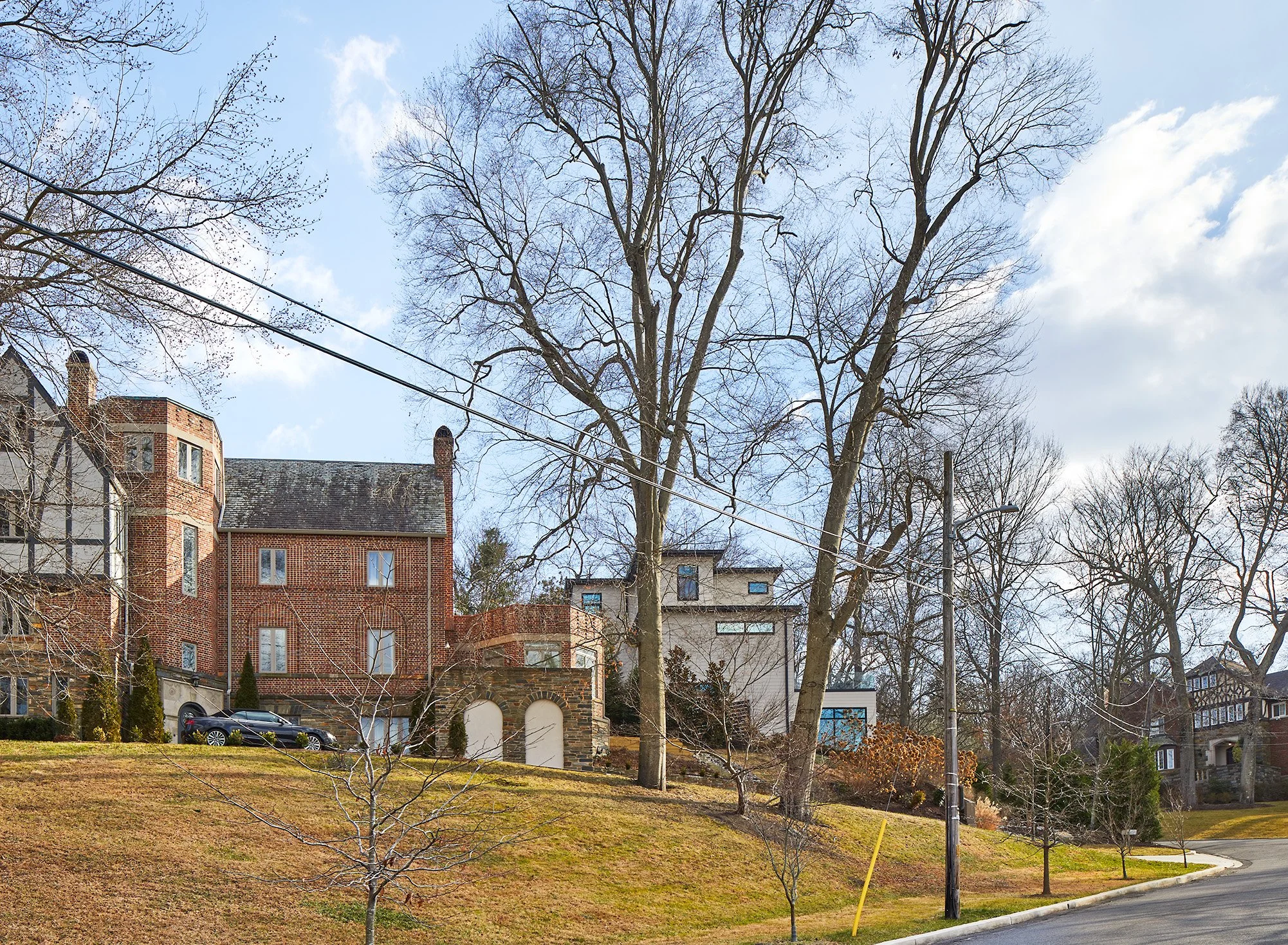
Photo by Anice Hoachlander
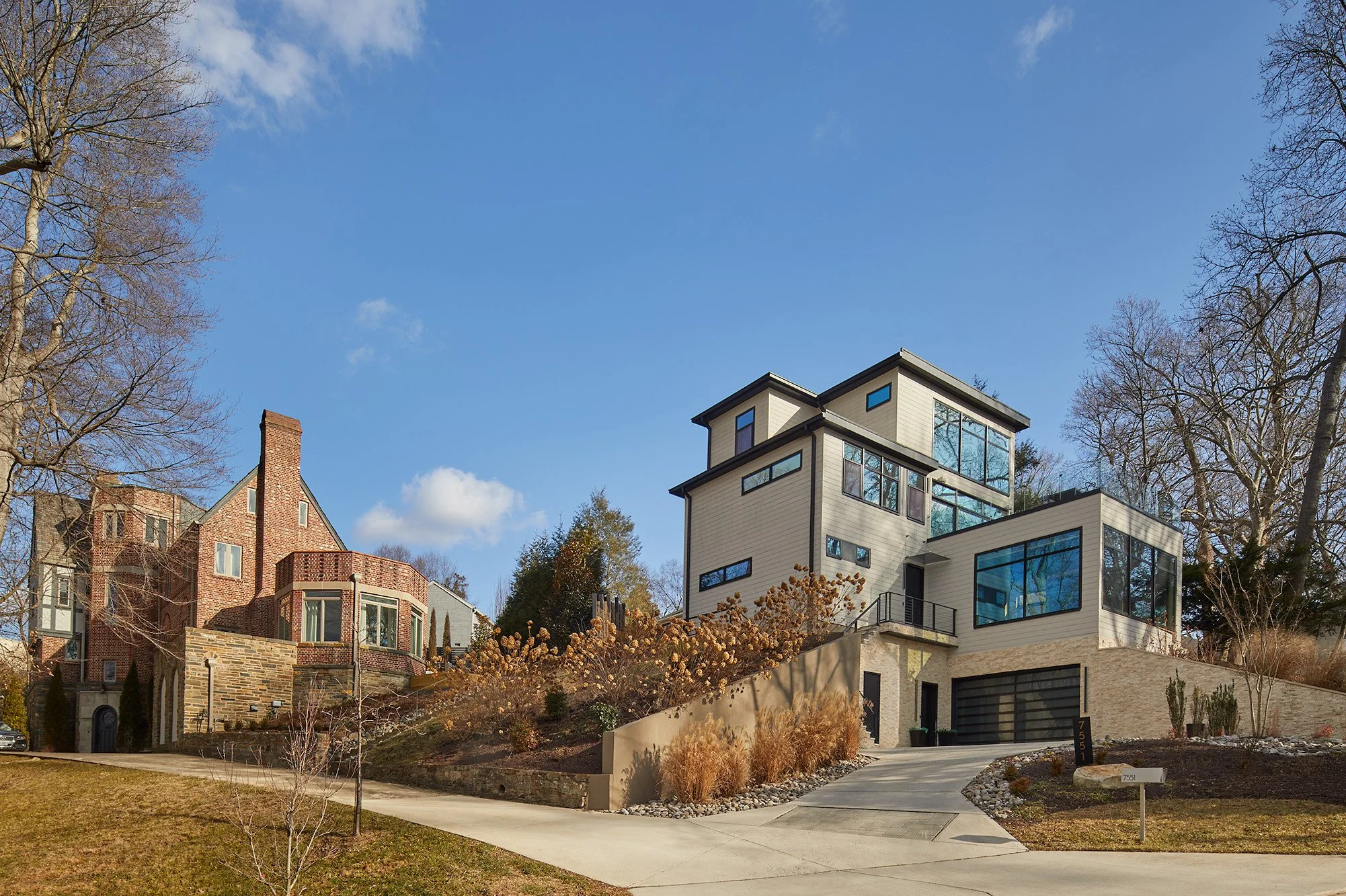
Photo by Anice Hoachlander
On an adjacent property, a Tudor-style mansion stood proudly overlooking the hillside and Rock Creek Park to the West. Colonial Village is predominantly Tudor-style. Given its larger than the typical house scale, the mansion provided guidance in terms of massing. It is composed of various volumes, layered front to back and from the center to the edges, it is site-specific, as sculptural as it is traditional and complex enough to be architectural interesting.
As the result of the complex site conditions, our project became an accumulation of volumes from the onset. Like the Tudor mansion, it is clearly visible from various angles and must respond to varying topographic conditions, orientation, views, and access constraints. Not entirely by coincidence, its massing echoes that of the mansion to a certain extent. The living room volume at the front of our house has a similar relationship to the house’s main volume as the faceted volume on the side of the mansion. Both have as much glazing as possible and provide expansive views of their surroundings.
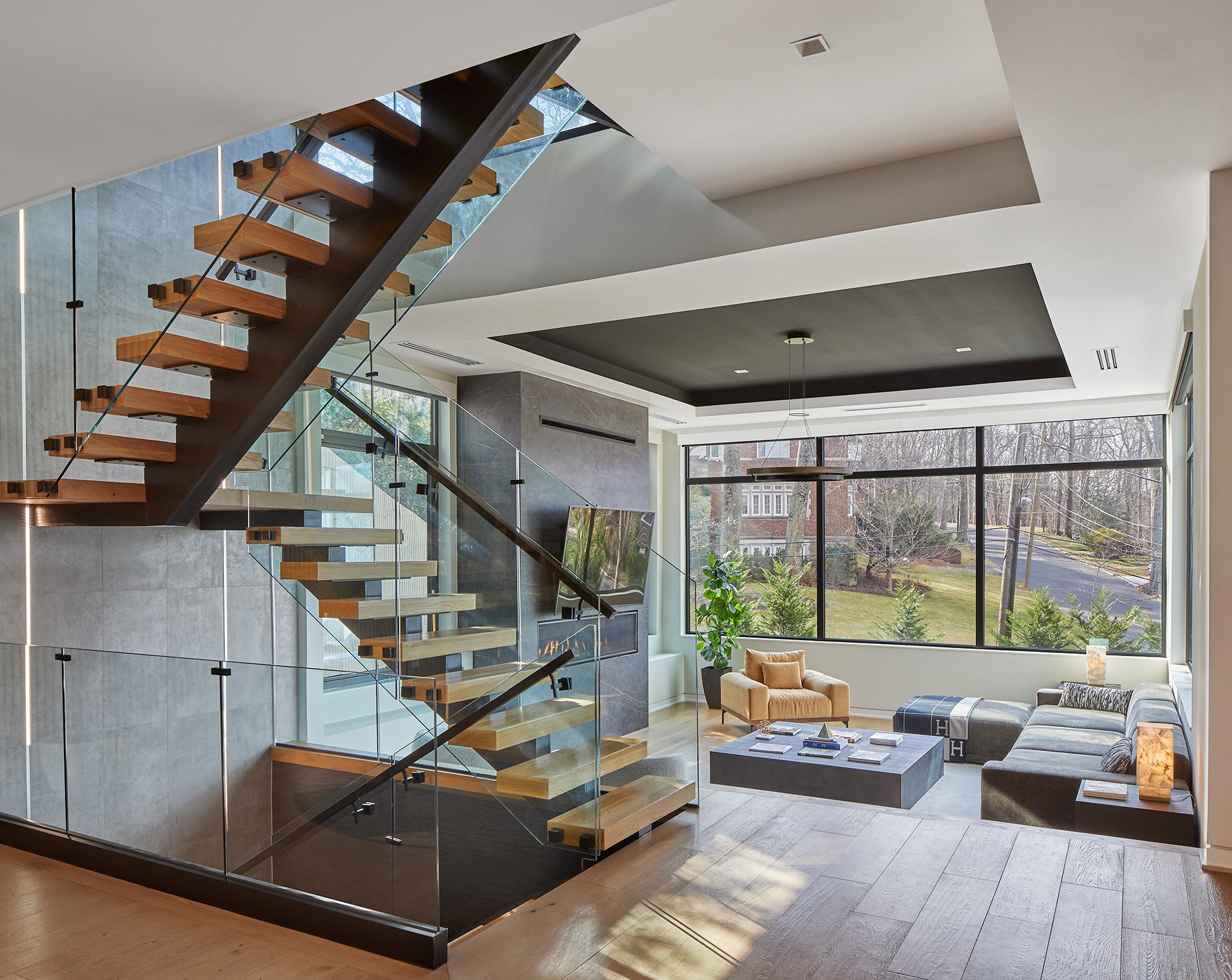
Photo by Anice Hoachlander
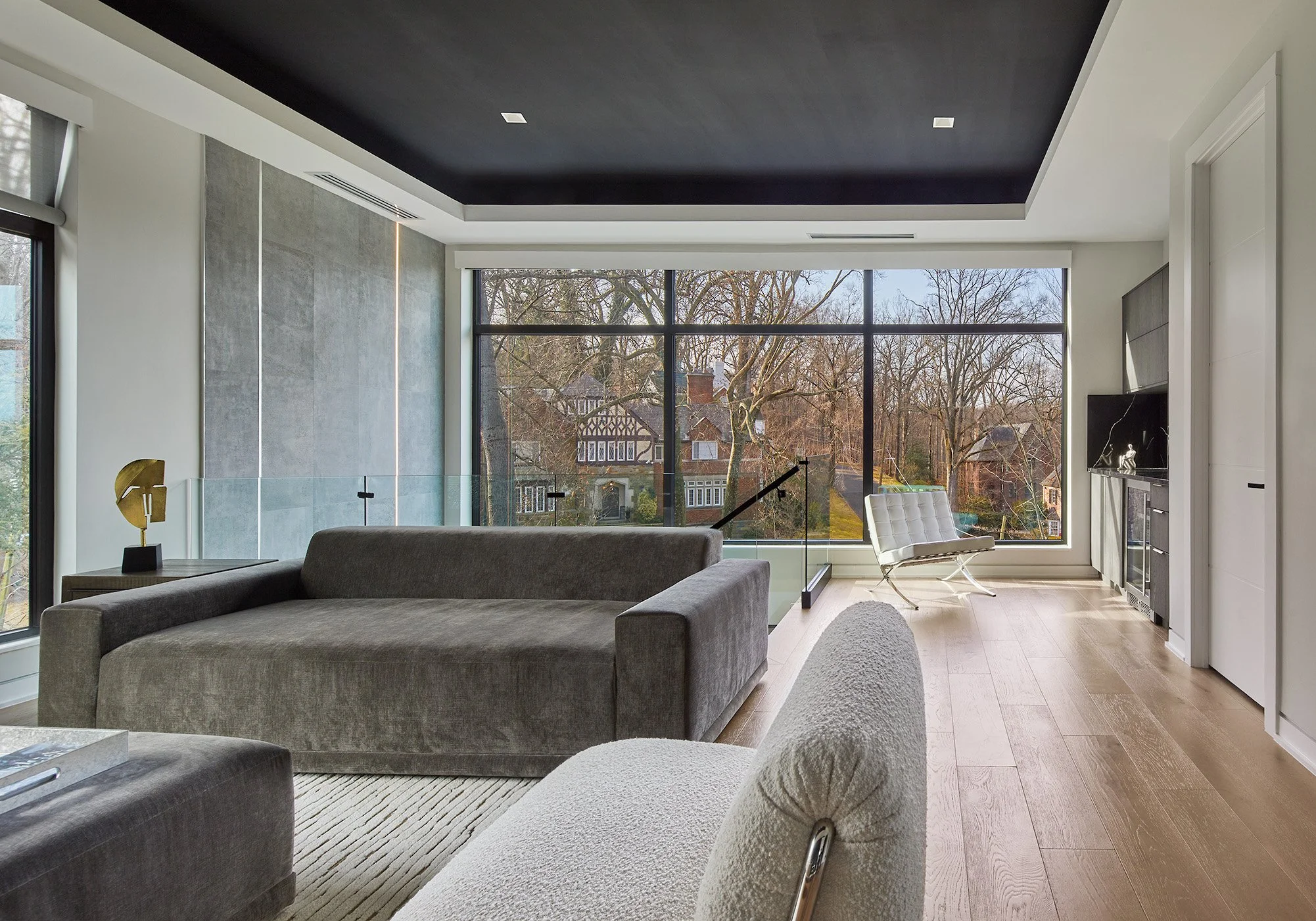
Photo by Anice Hoachlander
One might say that both houses, despite having radically different architectural styles, respond to their site conditions in similar ways, making them relate to each other. By focusing on what architecture does, instead of what it looks like, my goal was to achieve contextual compatibility without making it look forced, contrived, uninspiring.
As is often the case in our projects, the traditional context is framed, objectified, even put on display through strategic window placement. The end result is a house that cannot be removed from its site, or its context, as it would simply not work anywhere else.
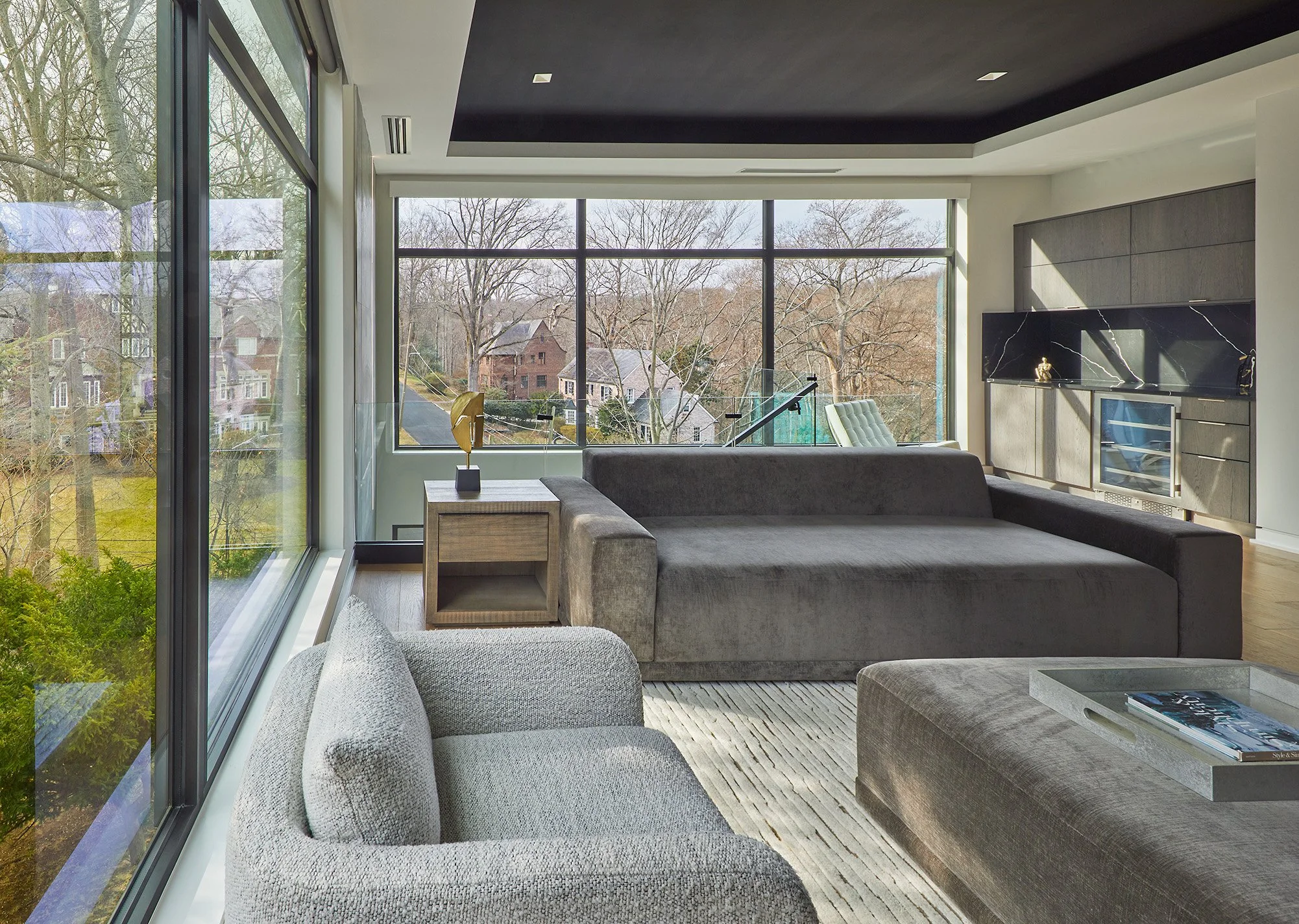
Photo by Anice Hoachlander